A law is valuable, not because it is a law, but because it is right in it.

Legal Advice

Welcoming Congregations

a
Criminal Law Aid
a
Business Law Advices
a
LEGAL ADVICE

Dedicated to Law & Orders

The rule of law is a jewel of great value. It is the means by which we do public and private justice.

Learn about Law & Orders

Why specialise in digital law?

When deciding which postgraduate course to study, it is important to evaluate all the possible variables. And detect the one that allows us to differentiate ourselves in the market and be more competitive. Currently, the digital world is facing exponential growth with an impact on all sectors. Therefore, below, we present some of the reasons why specializing in Digital Law will make you the lawyer of the future:

The Blockchain is Already Here!

And with it the need for specialized lawyers in this technology that guarantee transparency, security, and legality in the financial markets.

Technology Has Brought With it New Crimes

that generate debate around the world. The markets need lawyers prepared to legislate, classify and regulate this new cybercrime.

LegalTech was Born as a Support to Improve

automate and make the work of an office more efficient. Thanks to its appearance, a wide range of opportunities have been opened for those lawyers capable of specializing and mastering these new technologies in constant evolution.

Cookies, Grooming, Pharming, Cyberbullying, Spoofing, Phishing …

Do you know all these terms? Do you know how to deal with a case involving these concepts? If you do not have specialized knowledge and a digital training framework, you could lose customers and become obsolete in the market.

According to a Report by S21sec

Cybersecurity company, 2019 will be a challenging year for the industry, as scenarios, technologies, and types of attacks will become increasingly complex.

The Latest Figure From the OEDI

The Spanish Computer Crime Observatory indicates that 81,307 cybercrimes were committed in 2017 alone. Furthermore, according to the Civil Guard Technology Division, cybercrime is growing annually at a rate of between 40% and 50%. Cybercrime is a new territory full of opportunities for those firms that know how to adapt to changes.

In order to respond to all the challenges mentioned above. The ICAM has developed a Master’s Degree in Digital Law. Innovation, and Emerging Technologies, is a program that was born with the firm intention of training great professionals and providing them with the necessary knowledge so that they can respond to the digital transformation that the legal sector is currently experiencing.

If you want to specialize in the hands of the best professionals in the sector. Combining up-to-date theoretical knowledge and practical workshops, consult our Study Plan and sign up. You are one step away from becoming the lawyer of the future!

You may like to read HISTORY OF HUMAN RIGHTS

History of human rights

Since the origin of humanity and due to the very nature of human beings. We have the need to impose rules for better coexistence. Likewise, according to some writers, he has hierarchical needs and finds in human rights a way to guarantee the integral development of him as a person. Of course, human rights did not come out anywhere but have been built. And have gone through stages that we will analyze below.

The new audiovisual law in five keys

The audiovisual sector must assume as soon as possible the new rules introduced by the recently approved General Audiovisual Law Communication (LGCA). And learn to live with them to face the new challenges that lie ahead. We summarize, in 5 points, the most relevant modifications.

What is the importance of law in society?

Have you ever wondered how the world would work without rules and regulations? The importance of law in society lies in the fact that. Without it, everything you know would be in chaos. No one would be interested in protecting the rights of individuals. And justice would not be applied, therefore, crimes would not be punished. In this article you will find out why studying Law is a good option to contribute to society!

Organic Law of the Environment

The law establishes the provisions and guiding principles for the management of the environment. Within the framework of sustainable development as a fundamental right and duty of the State and society. To contribute to the safety and achievement of the maximum well-being of the population and to the maintenance of the planet, in the interest of humanity. Likewise, it establishes the norms that develop the constitutional guarantees and rights to a safe, healthy, and ecologically balanced environment.

Top 5: Best Books on the Law of Attraction

At the end of 2017, I was given the book Positive Mental Attitude by Napoleon Hill. Thanks to that book I realized that I had allowed myself to be influenced by the people. And spaces around me and now I had a pessimistic attitude. Having this kind of negative attitude did not allow me to see all the good things in my life. Nor did it allow me to attract more positive energy to my day today. After reading this book, I decided to actively change my attitude and focus on finding everything I could be thankful for and enjoy in my daily life. From that moment on I couldn’t do anything but continue to investigate more about the Law of Attraction and begin to enjoy the benefits it has brought to my life.

Professional cameras: Which is the best of 2022?

Capturing the moment through photography is a concept that has been present in our society since the creation of the first camera. Whether it is to have a “visual memory”, capture the details of a facial expression, show the beauty of a city, or the details of a product for merchandising. Currently, almost everyone wants to take pictures at certain times, either with a camera or a mobile.

However, professional cameras go much further and allow us to reach the pinnacle of photography quality. Over time, they have become the best tool for any type of photography that we want to do and are suitable for both amateur and professional use. In this article, you will discover everything you need to know about professional cameras in order to choose the one that best suits your tastes and needs.

The Most Important

  • Professional cameras are complex electronic devices, due to their large number of components. These work together to provide photos with great image quality.
  • Not all professional cameras are the same, each one has certain components as well as specific characteristics. Professional cameras can be classified into different types according to their mode of operation, style/type of photography, and characteristics of their components.
  • When choosing a professional camera, several aspects must be taken into account, such as the type of photography we want to take, the use we are going to give the camera, and our level of skill in the field of photography.

The Best Professional Cameras On The Market: Our Recommendations
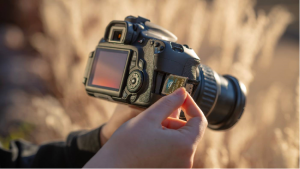
Professional cameras guideline

Sometimes it can be complex to choose a professional camera due to all its elements, characteristics, and typologies. But don’t worry, because we have prepared a special selection of the best professional cameras on the market and we have classified them into different types to make it easier for you to choose your professional camera.

Buying Guide: What You Should Know About Professional Cameras

Professional cameras due to their various components are considered complex electronic devices. This offers us a lot of flexibility when taking photos and allows us to adapt the camera to our tastes and photography preferences.

However, sometimes the complexity of its operation can overwhelm people who do not have an advanced command of photography and the use of cameras. Whatever your case, don’t worry, because we have prepared a guide answering the most common questions from users.

What Are Professional Cameras?

Professional cameras are electronic devices of a certain complexity due to all the elements that compose them and their operating process. They usually have an interchangeable lens that allows us to modify the zoom range with great image quality.

They stand out for the large number of manual adjustments they have since it is very versatile. And customizable product and we can adapt it according to our tastes and photography technique/style. They have an electronic viewfinder and a large photosensitive surface.

What Elements Makeup Professional Cameras?

One of the main characteristics of professional cameras is the great variety of elements that compose them. All of them are necessary to obtain a good image quality and the final result of the photograph. Next, you will discover what they are:

Objective: It is an optical system that is made up of a set of convex lenses. It is the part of the camera that directs light rays towards the sensor. Its two main characteristics are the focal length and the coverage angle. The focal length (zoom) is expressed in millimeters. And determines how close the image is. The angle of coverage is the field of view covered by the target. If the focal length is longer, the angle of coverage will be smaller.

Diaphragm: It is located inside the lens and its function is to adjust the intensity of the light that reaches the sensor.

Sensor: Its function is to transform the optical image created by the objective into a series of electrical signals that will give rise to the digital image.

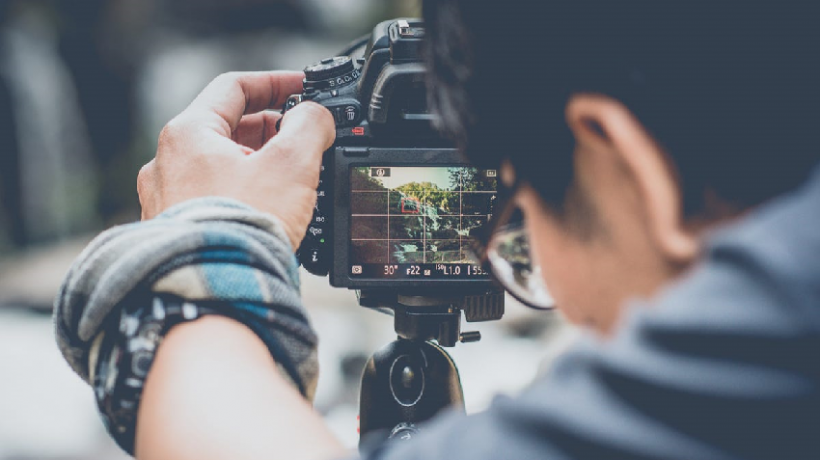
Viewfinder: It is the component of the camera that allows framing and focusing the image. It also allows you to preview the photo before taking it.

Shutter: Its main function is to control the exposure time. And the light to which the sensor will be exposed.

Screen: It is a characteristic component, especially in digital cameras. Its main functions are to display the images behind the photos, preview the image, and access the camera configuration settings.

Buttons and control dials: SLR cameras tend to have more buttons as their use is more complex, while compact cameras tend to have fewer. They allow you to control the camera settings as well as the photography parameters.

What Types Of Professional Cameras Are There?

Today we can find a wide variety of cameras on the market according to their style, level of photography, and mode of operation. However, within cameras for professional use, we can distinguish three types of cameras. High-end compact cameras, reflex or DSLR cameras, mirrorless cameras, and medium format cameras.

Compact cameras differ mainly by their fixed lens, that is, they do not have an interchangeable lens. This makes them lighter and easier to use. However, only the high-end ones are of a professional level.

The higher-end ones offer a larger sensor, better image quality, and usually include better optics and luminosity.

SLR or DSLR cameras are the ones that are most often classified as professional cameras. They use a mirror (reflex) that reflects light and directs it towards the viewfinder. They are cameras with a more complex operation, larger, and with enormous image quality.

Mirrorless cameras, on the other hand, do not have a mirror or an optical viewfinder. They use an electronic viewfinder and their size is smaller. Medium format cameras are mainly known for the large size of their sensors. Which provides images with a very wide dynamic range.

You may also be interested in PHOTOGRAPHY TIPS, 5 SUPER USEFUL TIPS TO START APPLYING

Photography Tips, 5 super useful tips to start applying

Nowadays, photography is an indispensable tool to communicate. Just look at your cell phone and, without having to open Instagram. You will notice that you have a wallpaper that already gives clues to your personality. Photos are everywhere! And, for that reason, now we are going to give you 5 photography tips so that yours are enviable.

Maybe you are interested in pursuing a career in photographic art and the like. Or you are the type of traveler who is crazy about photos and you want to take the best ones to share them on your social networks. So, don’t miss these tips for taking pictures that you can put into practice right now. Get to know them!

5 photography tips to apply right now

Best photography tips

Photography means, etymologically, writing with light. We do not want to get too theoretical, but knowing the origin helps to find the artistic and social value of the images that we record with our camera.

With these tips, you will discover that taking photos is much more than just focus and shooting. All ready? Here they go!

Start With What You Have

It is said that a camera does not make the photographer. And there is a lot of truth in that. If you are just starting out, you should know that the basic rules of photography can be applied with your cell phone camera or a simpler one. Being a visual arts discipline, the rules and concepts are similar to those of painting and drawing.

So don’t underestimate the tools you have. Remember that you put the “soul” of your photos, regardless of whether you do it with your cell phone or with the most expensive camera. Once this level is unlocked, you can go looking for better equipment. The most advisable thing is to save to travel and practice these photography tips with your mobile in unknown lands.

Does the law of thirds ring a bell?

Although you may know it in another way, practically all cell phones have the option to activate a grid in their configuration. This becomes a guide that divides the image into three equal parts vertically and horizontally or nine in total. This function helps you to frame your photo in a balanced way.

One of the ways to achieve this is to position the most outstanding elements of the image. That you are going to capture in the corners of the rectangle that forms in the center of the screen. It is very applicable if, for example, you see the sunrise on the beach and you want to give a good proportion to the sun and the beautiful horizon that you are capturing.

Composition is a basic aspect of art and could not be missing from these photography tips. If you look closely, this same rule is applied in painting and film to achieve an adequate weight between the elements of the image.

Better Avoid The Flash

If photography is writing with light, this refers primarily to natural light. It is much better to seize the day for many reasons. Try taking a photo with flash and then the same without it. You will notice that the colors maintain their tonality and the light remains uniform throughout the image and not just in the center.

In addition, you avoid the formation of hard shadows that do not go with what you want to express. The flash, including the LED on cell phones, is recommended in very low light situations or when you have difficulty using a tripod.

For example, when you are backlit, in the shadows of a sunny day, in night photos, or in fast movements. Such as those of an extreme athlete in full swing that requires a fast capture with a clear image.

Get Used To Using A Tripod

As we told you a few lines ago, a tripod is your best ally if you want to take spectacular photos. Especially when there is little natural light. If you are going to Canada, the United States, or Ireland to see the Northern Lights, having a tripod is vital. Why? Because the less light, the longer the camera takes to capture the photo.

You see, capturing an image takes fractions of a second. But if, for example, you want to photograph the full moon in an Australian landscape at night. This can take more than a second and in that small interval of time your hand can shake and your shot will be ruined.

That is why it is better to have stable support where to place the camera to shoot. And get an enviable photo. But, in addition to night shots, there are also other uses that you can give the tripod. And we will tell you about it in the fifth place of these photography tips.

Selfie Stick Vs. Timer

Selfie sticks, or selfie sticks, are widely used resources when your arm is not enough to cover everything you want to photograph. But if you want something more pro, you just have to resort to a very underrated feature in these times of social networks: the camera timer.

With the help of a tripod and your camera’s timer, you can include yourself in the portrait if there’s no one to give the camera to (or if you don’t trust anyone else to take the photo). It is enough to program the waiting time before the shot. You can apply this to a wide variety of photos: low-light landscapes, family photos, artistic self-portraits, etc.

You may also be interested in 8 PHOTOGRAPHY TIPS AND ADVICE FOR BEGINNERS