A law is valuable, not because it is a law, but because it is right in it.

Legal Advice

Welcoming Congregations

a
Criminal Law Aid
a
Business Law Advices
a
LEGAL ADVICE

Dedicated to Law & Orders

The rule of law is a jewel of great value. It is the means by which we do public and private justice.

Learn about Law & Orders

Why is it important to know the laws?

It is more than known that in each country, a rule of law must prevail that guarantees the full and free coexistence of its citizens. It is difficult to imagine in these times a state without laws. Then, it would give way to anarchy and disorder in society.

In the United States, there are Federal, State, and Local laws that regulate the actions of people in all fields of life, which apply to locals and foreigners. These not only contemplate duties but also rights. How important is knowing these laws for the Latino community?

In conversation with Hola News, the lawyer Christine Camacho, from the Weaver Bennet & Bland law firm, presented interesting data that helps us to know why we should be informed of the laws of this country, otherwise, we would run considerable risks of losing benefits that they contemplate.

Camacho, fundamentally argues to enforce our rights. Because many times out of fear associated with the consequences of having an undefined legal status in the United States. Some Latinos are not willing to go to court to claim rights that by law correspond to them. . From the outset, the lawyer clarifies that it is very unlikely that there will be immigration officers in a court to review the status of permanence in the nation of the citizens who attend there.

For this and other reasons, Camacho recommends that, in any legal situation. The first step that should be taken is to seek legal assistance from a professional. To advise and support you in any eventuality.

LEGAL ADVICE

Camacho explains to us that we must be aware that, in all civil proceedings, typified in legal codes, such as divorce, child or partner support, work accidents, traffic accidents, and others, “no person has to allow, Come from the country you come from, that your rights are violated, just because you do not have a citizenship, green card, visa or any document that establishes a condition allowed in the country. The laws are there and they are clear. If, for example, two people are married in Colombia and want to get a divorce here. They can open their case, adhering to what the law establishes and that marriage dissolution is specified.

Another situation could be in relation to the custody and support of the children or the partner.

Circumstances related to occupational or vehicle accidents are also highly regarded, according to the lawyer. A Latino who suffers injuries while doing his job or in a car collision.

To fight for our rights “you have to know the laws, put fear aside and act for your own benefit. If not, you will lose more than you can imagine. Thus, on the contrary, violating the law by ignoring it will also bring its consequences since ignorance does not free it from responsibility, ”Camacho explained.

ATTORNEY SERVICES

Weaver Bennet and Bland’s family lawyer also commented on high rates of Latino citizens who miss the opportunity to open cases before the court. Having all the conditions to claim what exactly belongs to them. It is for these reasons already exposed by the expert in-laws and judicial procedures in the United States. That we must take very seriously having at least a base of what the judicial statutes of this country establish.


What are the laws?

Laws are the set of legal rules issued by a legislator, that is, by a competent authority in the matter. Its function is to order, prohibit or allow something specific and concrete. Its compliance is mandatory for those who live under the rule of the same legal code to which the law belongs, such as the constitution of a country or its penal code.

Those who do not obey the laws are exposed to punishment by the forces of State order. They must defend the official legal framework and guarantee, at least in democracies, equal rights before the Law, that is, the rule of law.

Furthermore, no law can contradict the fundamental mandates of the Constitution or Magna Carta. This is because the laws have a certain type of hierarchy among themselves, in which the Constitution occupies the highest place so that any legislation must be subordinated to it. Laws are also the field of expertise of lawyers, judges, and legislators.

Origin of the laws

Laws have existed since man understood the need for a common code that distinguishes good from evil.

However, for a long time, human societies were at the mercy of the whims of law enforcement, such as judges.

This changed when the Babylonian King Hammurabi (1728-1686 BC) made the decision to have the laws in writing.

Thus the first code of law was drawn up, which was distributed among the people so that everyone could read and know it.

History of laws

The laws and their written supports have changed a lot throughout history. Many peoples devised their own codes and laws. Some required mutual agreement sustained in religious mandates, such as the Tables of Law. In others, they were imposed by force, as empires did with their conquered neighbors.

Special mention deserves the way of making the laws of the Roman Empire, the direct precursor of the western legal system. The first compilation of Roman Law was made during the government of Emperor Hadrian, who gave the instruction in 121 AD. C. to compile the laws in force.

The result was the Perpetual Edict. Its objective was to make the application of the law fairer since it would not depend on the memory or the will of the judges.

Later, the Edict was not enough due to the enormous number of laws that accompanied the growth of the Empire. For this reason, during the government of Justinian, a new Roman code was drawn up, called Corpus Juris Civilis and known as the Justinian Code (529 in its first version and 534 in the second).

The system of laws in the West then suffered a major setback during the Middle Ages. With the development of feudalism, laws were imposed on his fiefdom by each landowner or lord. However, religious laws were above all, under the surveillance of the Catholic Church and its institutions, such as the Holy Inquisition.

Later, as the kingdoms were unified and monarchs were crowned, both sets of laws became one. In this way, the absolute power of the monarch was maintained and the ecclesiastical clergy at his side in the government.

This last legal provision ended with the advent of the Modern Age. With it, the study of laws and the application of reason as a new precept of bourgeois societies developed. These arose from the French Revolution of 1789 when the laws governing the universal rights of humanity were declared.

Definitions of laws

Some historical definitions of law are as follows:

“The common consent of the city” Aristotle (384-322 BC)

“It is what the people command and establish” Gaius (c. 120-c. 178)

“Ordination of reason directed by the common good and solemnly promulgated by the one who cares for the community” Saint Thomas Aquinas (1224-1274)

“Legislation means the establishment of general legal norms, whatever the body that carries it out” Hans Kelsen (1881-1973)

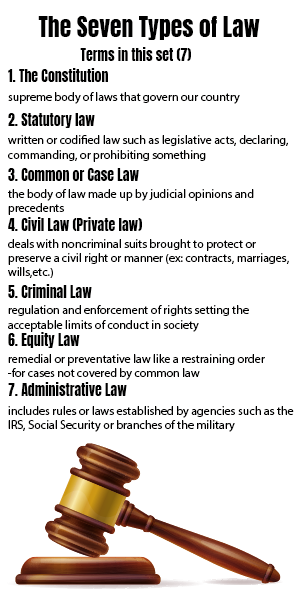
Types of laws

A very first division of the total body of laws distinguishes the fact of whether or not they are contained in a legal body of writing. Thus, we have:

  • Natural law. Natural laws are those that are based on the biology of man or on precepts considered extremely basic, elementary, of the human condition. These laws are proper to the mere fact of being human. They are considered prior and hierarchical above any written body of law.
  • Positive law. All those laws promulgated within the framework of a society and that have a written text that supports and contains them, such as codes and regulations. This law in turn is classified according to its mode of operation in:
  • Permissive. Those that provide a right or a possibility.
  • Prohibitive. Those that curtail freedom or restrict a right.
  • Declarative. Those whose content consists of definitions or formal explanations.

What are the laws for?

Laws serve primarily to dictate, prohibit or allow something in a specific society. By law the rules of the game are established, be it in the criminal, commercial, family, or any other possible field.

Societies that determine themselves are governed by their own laws, while those subjected to another are governed by those dictated by their colonizer. Laws are always backed by an authority or a power to which they are functional to maintain a specific order.

Who makes the laws?

Laws must be issued by a legitimate and recognized authority to be valid. They are the result of social, political, and legal institutions. Its approval generally follows some kind of protocols, which eventually lead to its dissemination among the people who must abide by it.

For example, in democratic republics, laws are the result of the work of the legislative body: Parliament or Congress. This legislative assembly is composed of representatives of the popular election expressed through a vote.

In other types of government, such as absolutist monarchies, laws are dictated by the will of the monarch. On the other hand, in theocratic societies, the laws are taken from some religious sacred text.

How do the laws work?

The laws work based on certain principles that are their own:

  • Generality. The law applies to all those who are contemplated in its content, without any qualifications or distinctions.
  • Mandatory. Compliance with the laws should not be optional, but imperative-attributive, committing a crime and deserving a punishment each time the provisions of the law are violated.
  • Permanence. The laws are in effect for time indefinite, until so provides the body that promulgates, either due to its replacement by another, or lack of need.
  • Abstraction and impersonality. Laws do not regulate or contemplate individual cases, but rather dictate behavior in the abstract, without being addressed to anyone in particular, but to the entire community.
  • Irretroactivity. The laws do not operate retroactively, that is, a crime committed before the law that prohibits it is passed. Laws always govern forward in time.
  • Ignorance does not exempt. Ignoring the laws, that is, not knowing that they existed, does not exempt us from the punishment provided by the law for breaking them.

How are the laws repealed?

Laws that are no longer desired or useful are repealed, that is, they are removed from circulation in society. This procedure, called repeal, corresponds to the legislative body of the company, and can only be carried out respecting the hierarchy of the laws.

Why are laws important?

Laws are the instruments by which human beings regulate our behavior in society. They provide us with a unique, similar code, with which to judge our actions and to know what is accepted or not by the population as a whole.

In addition, they define how problems that arise with the law should be resolved. In this sense, there are no lawless societies. Even if they are not official or if they are imposed by not exactly democratic types of authority.

How are laws written?

Laws usually involve a set of ordered and numbered articles (called articles ). In each one of them, the information on what the law defines prohibits, or authorizes is detailed.

Some laws are very long and include very specific articles. Others, on the other hand, are more general and expressly delegate the particular content to what is contained in other codes, norms, and laws. These articles are expressed in a general, timeless, and abstract way.

Shoplifting law: Facing criminal charges for shoplifting

If you run a retail business, you’ll already know what a problem shoplifting can be. But what are your rights as a shopkeeper?

Spotting a shoplifter

Each shoplifter will exhibit different behaviors, but some signs are typical. For example, if an individual is obviously trying not to be noticed, and looks hot and flushed, this can be suspicious. Another warning bell is if they are repeatedly picking items up and putting them down in the same area and looking around them.

Clothing is another giveaway. Shoplifters often wear clothing that is inappropriate for the weather – such as a big coat on a hot day – which they will use to hide items. They may also be carrying a sizeable bag for the same purpose. (Authority URL: British Retail Consortium)

Organized tactics

Organized thieves may well collide in groups to distract staff so that a shoplifter can take items without being spotted. Staff also sometimes collide with shoplifters. Some may switch over prices, and others will steal money by bringing back ‘fake’ returns – which can be stolen. Accidental stealing is also common, where the thief will pay for a single item, with another being held in view. If challenged, they will simply say it was accidental.

Detaining shoplifters

Primarily, you should take care of your – and your staff’s – personal safety, and train staff in these procedures. Staff must witness the theft rather than simply suspecting it. This will be a citizen’s arrest and it must only happen in certain circumstances. Because of the ‘reasonable force’ clause, this can be a difficult area, and most businesses prefer to have specialist security provision in the form of security guards.

It is well worth hiring the services of security guards in Gloucester who will be trained in the latest legislation and methods so that you can deliver effective and compliant stock control. contact Cuffgroup Security for more information about security guards. Invest in a good security system for extra peace of mind.

Also, be mindful of staff theft. Although it is less of a problem in the UK, compared to the USA, the values involved are typically sevenfold than the theft committed by a customer. Look carefully at your procedures and processes, particularly around stock control and delivery takes.

On Workplace Diversity, Do Law Firms Practice What They Preach?

Workplace diversity is more than just a buzzword — it’s imperative. Employers have a legal and moral obligation to ensure that members of protected classes — gender, race, religion, and other characteristics — don’t face discrimination or unfair treatment at work due to their background or beliefs.

These Lawsuits Changed the Legal Landscape Forever

The American legal system is a sprawling beast with numerous components. Cases can broadly be divided into two categories — tort (or civil) cases and criminal cases — though that of course understates the complexity of the situation. Although criminal cases tend to get more attention to their often sensationalistic nature and the fact that the liberty of the accused is often at stake, both criminal and civil cases can have an impact far beyond those involved.

Vehicle maintenance law: Rights and Responsibilities

We all have detected the phrase, “prevention is healthier than cure.” though this phrase is applied to health, it’s equally true for the upkeep of the vehicle. If your vehicle, whether or not it’s an automobile, a motorbike, or perhaps a bus isn’t maintained on a daily basis, it will cause several issues. A number of these embody vehicle deterioration, pollution, and even serious threats on the road. Here square measure some vital key factors that if thought-about can assist you to keep your automobile well-maintained.

Knife and Self Defense Laws in California

California is a progressive state, which means that its views lean towards the more liberal side of politics. Gay marriage is legal and capital punishment is shunned. When it comes to weapons laws, California is liberal, but also pragmatic – they know how to create penal codes that punish people who use weapons legally and illegally. For instance, if you were trying to protect yourself from an intruder, you probably wouldn’t be charged if you killed the intruder. Plus, the constitution protects the right to bear arms. When it comes to owning and using knives, the same tenets, regulations, rights, and laws apply.

Is Law School the Right Move for You?

It can be easy to get excited about one day becoming a lawyer, judge, or even a politician, but once you realize that you will need to get a law degree, the thought might be less appealing. Law school may be a very daunting experience, but it’s a very necessary and effective way to prepare a person for a career working in law. Before you actually start applying to law schools, you need to make sure you are prepared for the challenges that lie ahead.